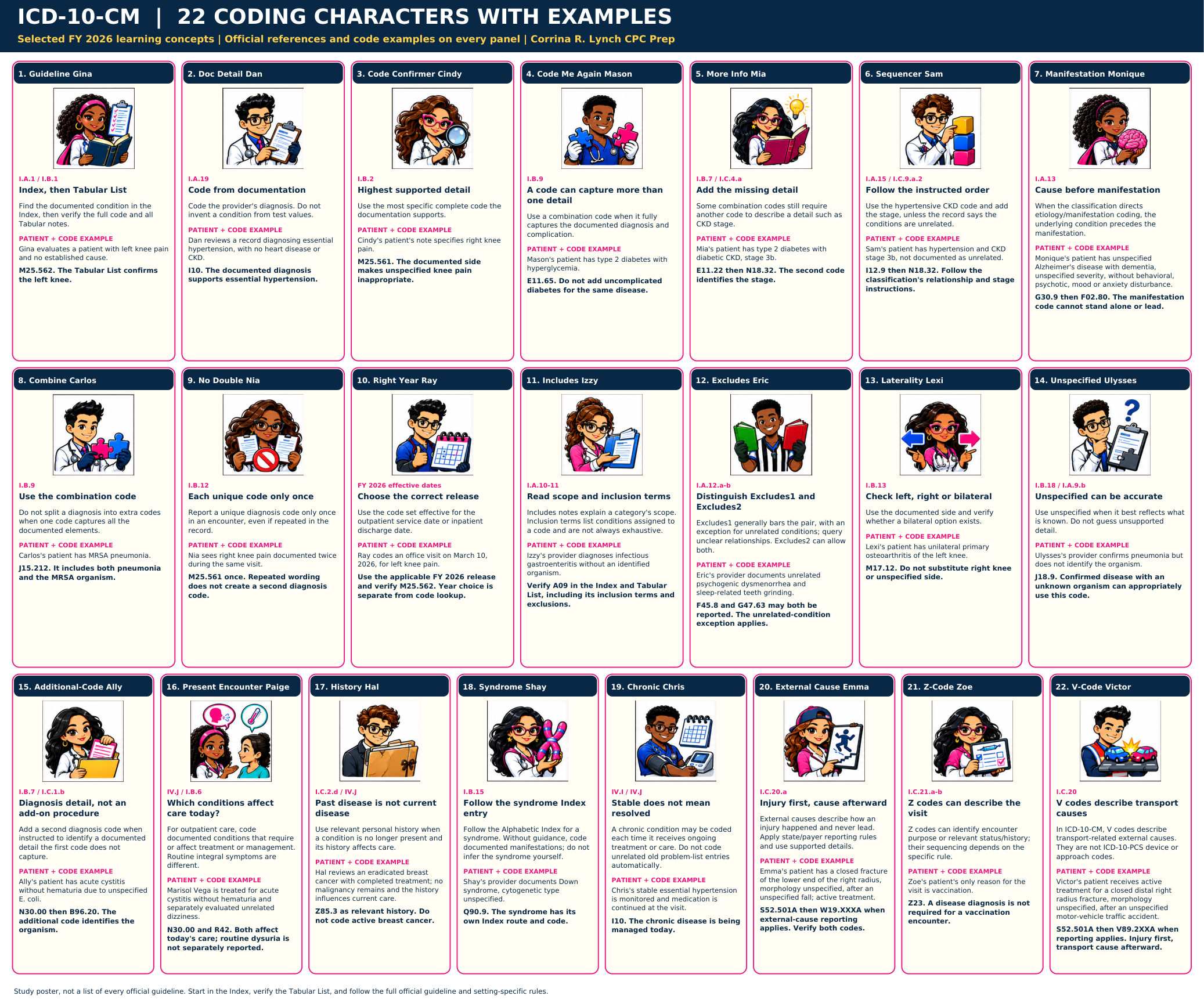
Great evening, future CPC Coders! 💗 Your Corrina’s Code Spot™ — Student Handout is now available under Resources.
Download the handout and practice Spot It • Search It • Support It • Code It. Keep the final checklist nearby during coding practice, and bring your questions to class.
Corrina R. Lynch Your CPC Instructor
NEW CLASS RESOURCES
📚 Chapter 4 & 5 Guideline Guides Are Ready
Great evening, future CPC Coders! Your new guides include guideline references, explanations, fictional coding examples and code answers.
Open Resources → Chapter Guidelines & Coding Examples. Review the guide with your assigned chapter and code book, and bring your questions to class. Read in your browser or print.
Corrina R. Lynch Your CPC Instructor
📚 NEW HOMEWORK ASSIGNMENT — CHAPTER 4
Hello, Future CPC Coders! 💗
Your new homework assignment is due Monday, November 9, 2026.
Great evening, future CPC Coders!
Today we will:
• Review the homework due today for Chapter 3, pages 1–60.
• Complete 15 multiple-choice questions.
• Complete 10 ICD-10-CM code lookup questions.
• Review the Chapter 4 PowerPoint.
Please check Additional Assignments for the questions and Presentations for the Chapter 4 slides.
Corrina R. Lynch
Your CPC Instructor
15 multiple-choice questions covering code-set roles, ICD-10-CM conventions, guideline application and fictional coding cases. Use your ICD-10-CM book and FY 2026 official guidelines. Submit online for automatic scoring; your best score is saved.
Work through 40 fictional patient reports. For each case, assign the requested diagnosis code(s), show sequence when required, and explain your decision using the assigned FY 2026 guideline references. Case 30 asks for a documentation action.
The student packet includes the questions and answer space. Use your ICD-10-CM Index, Tabular List and Official Guidelines.
Read ten short outpatient provider notes, look up the documented diagnoses, and submit your typed codes for automatic grading. Your best score is saved.
Look up ten documented diagnoses in the ICD-10-CM code book. Type your answers in the form, then print it or save it as a PDF. Answers are not submitted or automatically scored.
Practice applying the ten guidelines with 15 multiple-choice coding questions. Open and print the worksheet; answers will be discussed in class. This worksheet is not automatically scored.
Due Monday, October 19, 2026 · 10 multiple-choice questions · 10 points
Read Chapter 3: Integumentary System and Chapter 4: Musculoskeletal System in Anatomy for Coders. Answer five questions from each chapter. You may use the chapter materials. Submit to see your score immediately; your best score is saved in My Grades and Instructor Grades.
10 questions, 10 points. Five questions cover The Language of Anatomy and five cover Cells, Tissues and Body Organization.
Read Chapters 1–2 in Anatomy for Coders, then answer all 10 multiple-choice questions online. You may use the chapter materials. Submit to see your score immediately; your best score is saved to your account and instructor gradebook.
Get 21 homework PDFs, 21 chapter exam PDFs, the 100-question mock exam, and both student books. Student PDFs have questions and blank answer spaces, with no answer keys.
Homework completed in this portal is scored automatically. A PDF submitted in Teams needs instructor grading unless you create a separate quiz in Microsoft Forms.
USE CURRENT EXAM-YEAR EDITIONS
Required coding books
These books contain the official code sets students will practice using during class.
CPTCPT Professional
ICDICD-10-CM Expert
HCPCSHCPCS Level II
SEPARATE WELCOME SESSION
Class orientation
Meet your instructor, prepare your materials, and learn how the course will work before Chapter 1 begins.
SEP 217:30 PM Eastern • Zoom
COURSE GUIDE
CPC Course Syllabus
Review class expectations, required materials, anatomy and medical terminology foundations, and the 21-chapter schedule.
Two Letter-size pages. Print in portrait at Actual size (100%).
ORIENTATION AGENDA
Welcome and introductions Meet your instructor and classmates.
Course expectations Review attendance, study time, assignments, and grading.
Books and setup Confirm your code books and learn how to tab them.
CPC exam overview Understand question coverage, pacing, and the passing target.
Portal walkthrough Practice opening the textbook, selecting a chapter, downloading pages, and sending a message.
Prepare for Chapter 1 First class meets October 1, 2026.
21-CHAPTER CLASS SCHEDULE
Class calendar
Mondays and Thursdays • 7:30–9:30 PM Eastern • October 1–December 14, 2026
21Class meetings
2 hoursEach class
Mon & ThuWeekly schedule
Chapter
Date
Time
Class topic
1
Thursday, October 1
7:30–9:30 PM
Introduction to Medical Coding
2
Monday, October 5
7:30–9:30 PM
ICD-10-CM: Introduction, Structure & Conventions
3
Thursday, October 8
7:30–9:30 PM
ICD-10-CM Official Coding Guidelines
4
Monday, October 12
7:30–9:30 PM
Infectious, Neoplasms, Blood & Endocrine
5
Thursday, October 15
7:30–9:30 PM
Mental, Nervous, Eye & Ear
6
Monday, October 19
7:30–9:30 PM
Circulatory, Respiratory, Digestive & Skin
7
Thursday, October 22
7:30–9:30 PM
Musculoskeletal & Genitourinary
8
Monday, October 26
7:30–9:30 PM
Pregnancy, Congenital, Injury & Z Codes
9
Thursday, October 29
7:30–9:30 PM
Introduction to CPT
10
Monday, November 2
7:30–9:30 PM
Evaluation and Management (E/M)
11
Thursday, November 5
7:30–9:30 PM
Integumentary & General Surgery
12
Monday, November 9
7:30–9:30 PM
Musculoskeletal Surgery
13
Thursday, November 12
7:30–9:30 PM
Respiratory Surgery
14
Monday, November 16
7:30–9:30 PM
Cardiovascular Surgery
15
Thursday, November 19
7:30–9:30 PM
Digestive Surgery
16
Monday, November 23
7:30–9:30 PM
Urinary Surgery
—
Thursday, November 26
No class
Thanksgiving Day
17
Monday, November 30
7:30–9:30 PM
Genital, Maternity & Endocrine Surgery
18
Thursday, December 3
7:30–9:30 PM
Nervous System Surgery
19
Monday, December 7
7:30–9:30 PM
Eye, Auditory & Radiology
20
Thursday, December 10
7:30–9:30 PM
Pathology and Laboratory
21
Monday, December 14
7:30–9:30 PM
Medicine Section
Homework and chapter exams: Complete each chapter’s 10-question homework and 25-question quiz after class.
STUDENT COURSE AGREEMENT
CPC Prep Contract
Review the complete agreement, then sign and submit it securely through Adobe Acrobat Sign.
STUDENT INFORMATION
Student Contact Information Form
Download the fillable PDF, complete your contact information, save your copy, and return it privately to Corrina Lynch. Do not post completed forms in a class discussion.
How to sign: Select Sign contract online, complete every required field, add your signature, and submit the form. Adobe will provide confirmation when it is complete.
CPC STUDENT TEXTBOOK • CHAPTERS 1–21
Chapter Resources
Read a chapter and complete its homework here. Use Class Quizzes, Flash Cards and Presentations for the other course materials.
The complete textbook, Chapters 1–21 and reimbursement, with instructor answers inserted in bold red in the book. Includes the original teaching boxes, worked cases and chapter-review keys, plus the current quiz and homework questions with answers. Chapter objectives now have numbered instructor explanations in bold red.
Instructor sign-in required. This book is not available to students.
Quizzes, homework and chapter teaching materials
Open a chapter to find its 25-question quiz and 10-question homework with correct answers and explanations, plus matching classroom resources. Print or save the instructor guide as a PDF from your browser.
Full chapter, six worked patient scenarios, 10 review questions, answer key and teaching prompts. Instructor sign-in is required. Use your browser’s Print option to print or save a PDF.
Send a private message to your instructor and read class announcements.
MESSAGE TO ALL STUDENTS · CORRINA R. LYNCH
📚 Today’s Class Assignment
Great evening, future CPC Coders!
Today we will:
• Review the homework due today for Chapter 3, pages 1–60.
• Complete 15 multiple-choice questions.
• Complete 10 ICD-10-CM code lookup questions.
• Review the Chapter 4 PowerPoint.
Please check Additional Assignments for the questions and Presentations for the Chapter 4 slides.
Corrina R. Lynch
Your CPC Instructor
Practice the full exam experience with original questions covering anatomy, terminology, ICD-10-CM, CPT, HCPCS Level II, compliance, modifiers, and coding cases.
Your class presentation with chapter references, diagnosis examples and official excerpts. Use the matching official PDF to verify the applicable guidelines.
Choose Learn the Code Ranges, Anatomy Chapters 1–5, or your CPC textbook chapter below.
NEW · CHAPTER CREW · ALL STUDENTS
Learn the Code Ranges — ICD-10-CM Chapters 1–22
22 character flashcards covering A00–B99 through the ICD-10-CM classification chapters, including Z codes and U codes. These are the diagnosis classification chapters, separate from your 21 Medical Coding Mastery textbook chapters.
The chapter and question are on the left; the character and code range are on the right. Cover the answer to practice, or print single-sided at 100%, cut and fold. Chapter ranges are navigation guides, not complete reportable diagnosis codes.
100 study cards · 20 per chapter · Questions and answers side by side. Print single-sided at 100% size; cut along horizontal lines and fold at the dashed line, or cover the answers to practice.
Practice the four-step habit: Spot It • Search It • Support It • Code It. Use the guide’s practice questions and final checklist as you work through coding examples.
Open in Microsoft Word or a compatible document viewer.
CHAPTER GUIDELINE GUIDES · FY 2026 COURSE
Chapter Guidelines & Coding Examples
Use these selected teaching priorities alongside your assigned chapter and complete code-book instructions. Chapters 4-8 cover ICD-10-CM; Chapter 9 introduces CPT.
Chapter 4: Guidelines and coding examples
Read these in Chapter 4 under Chapter Resources.
Chapter 5: Guidelines and coding examples
Read these in Chapter 5 under Chapter Resources.
Chapter 6: Guidelines and coding examples
Read these in Chapter 6 under Chapter Resources.
Chapter 7: Guidelines and coding examples
Read these in Chapter 7 under Chapter Resources.
Chapter 8: Guidelines and coding examples
Read these in Chapter 8 under Chapter Resources.
COURSE CHAPTER 9 · PDF STUDY GUIDE
Chapter 9 Guidelines with Coding Examples
Introduction to CPT: complete services, component coding, parenthetical notes, add-on codes, modifiers and included services. CPT rules and Medicare policies are identified separately.
Check the posters: The A–Z chart contains entries to correct, including COVID-19 history (verify Z86.16) and Zika (verify A92.5). The 20-case poster summarizes I.B.8: report both acute and chronic only when separate Index entries exist at the same indentation level, with acute first, unless other instructions apply.
OFFICIAL REFERENCES & TEACHING MATERIALS
Resources
ICD-10-CM Official Guidelines for Coding and Reporting, organized by fiscal year and effective date.
UPDATED FY 2026 · GUIDELINES WITH CHARACTERS & CODING EXAMPLES
Start with the all-in-one guide or choose a smaller part. Each teaching card brings the reference, plain-language rule, cartoon, fictional case, and coding answer together. The official guidelines are organized into Sections I–IV; there is no Section V in this document.
All-in-one Sections I–IV Cartoon Learning Guide
362 teaching cards plus the full official wording with examples.
362 illustrated teaching cards across Sections I–IV, plus the full official guideline wording alongside worked examples. Includes a clickable guideline finder.
ICD-10-CM Character Cards: Volume 3 — Infectious Diseases
62 practice cards covering Section I.C.1, plus an opening neoplasm card. Each card includes a rule, a fictional case, and the answer with its rationale.
Meet Guideline Gina, Present Encounter Paige and the other named characters. Each panel includes a guideline reference and coding example. Paige’s IV.J card uses Marisol Vega’s case. The poster shows the original 22 starter concepts. The expanded printable file now has 400 teaching cards in this same named-character style, covering Sections I–IV and the Present on Admission appendix, with the full official document included for details and exceptions.
Corrected for ICD-10-CM diagnosis coding: Ally teaches additional diagnosis codes, and Victor teaches transport-related external causes.
18 patient scenarios with guideline references, coding explanations and common mistakes. An 11-page companion to the teaching PowerPoint, checked against FY2026 sources.
Read the chapter: Specific Guidelines and Examples
Learning objectives
After completing this chapter, you should be able to:
Distinguish local infection, sepsis, severe sepsis and septic shock; follow organism and resistance instructions.
Distinguish active malignancy from personal history and sequence by purpose of encounter.
Use documented anemia specificity and check code-first notes.
Choose diabetes combination codes, verify additional-code notes and distinguish temporary from ongoing medication use.
Use these FY 2026 teaching examples with the Alphabetic Index and Tabular List. Follow the full official rule for exceptions.
Official ICD-10-CM Chapter 1 · A00–B99
Infectious and parasitic diseases
Begin with the provider’s diagnosis and the site of infection. Then check whether the code already captures the organism, the manifestation or the resistance. A local infection and a systemic infection are different diagnoses, and timing at hospital admission can change their order.
Guidelines in this lesson
HIV — I.C.1.a
Use B20 for documented HIV disease or a history of an HIV-related illness. Asymptomatic HIV status without that history is Z21.
Example: A routine visit documents asymptomatic HIV status and no prior HIV-related illness: Z21.
Organism and resistance — I.C.1.b; I.C.1.c
Check whether the infection code already names the organism or resistance. Follow additional-code instructions when it does not.
Example: Acute cystitis without hematuria due to E. coli: N30.00 + B96.20.
Sepsis and the localized source — I.C.1.d.4
When sepsis and its localized source are responsible for admission, sequence the systemic infection first. If the patient is admitted for the local infection and sepsis develops later, sequence the local infection first.
Example: Hospital admission for sepsis due to UTI, organism and site unspecified: A41.9 then N39.0.
Severe sepsis and shock — I.C.1.d.1.b; I.C.1.d.2
Code the systemic infection, the applicable severe-sepsis code, and associated acute organ dysfunction as required. Query when the relationship is unclear.
Example: Sepsis of unspecified organism admitted with documented sepsis-related AKI and no shock: A41.9 + R65.20 + N17.9.
MRSA — I.C.1.e.1
Distinguish infection from documented colonization. Do not duplicate MRSA already captured in a combination code.
Example: Confirmed MRSA pneumonia: J15.212; no additional B95.62.
Confirmed Zika and COVID-19 — I.C.1.f; I.C.1.g.1.a
Apply the confirmation rules for each infection; do not infer either from suspicion alone.
Example: Provider confirms current COVID-19 at an office visit: U07.1.
Worked coding example
Scenario
The provider diagnoses a urinary tract infection, site not specified, due to E. coli.
Chart clue
The site is unspecified; the organism is documented.
Index starting point
Infection → urinary tract; then locate the E. coli organism code.
Tabular verification
Confirm the candidate code description, required detail, and all sequencing or additional-code instructions.
Final code(s) and rationale
N39.0 then B96.20. Verify the additional-agent instruction at N39.0.
One code or more than one?
Oral candidiasis is captured by one code, B37.0. An E. coli UTI with no specified site takes two codes: the infection plus the organism. The Tabular instruction is what tells you to add the second code.
Diagnosis
Oral candidiasis
Index
Candidiasis → mouth
Tabular
Verify B37.0, candidal stomatitis.
Code
B37.0 describes the documented condition.
Why sepsis timing matters
I.C.1.d.4: If sepsis due to pneumonia occasioned admission and no organism is specified, report A41.9 followed by J18.9. If pneumonia occasioned admission and sepsis developed later, report J18.9 followed by A41.9. The admission reason, not the order in which diagnoses appear in the note, determines the difference.
I.C.1.d.2: If septic shock is documented in a non-postprocedural case, sequence the systemic infection before R65.21 and add codes for other documented acute organ dysfunction as applicable. Use the separate postprocedural instructions when relevant.
Official ICD-10-CM Chapter 2 · C00–D49
Neoplasms
A cancer diagnosis and the reason for today’s encounter do different jobs. Find the site and behavior in the Neoplasm Table, verify laterality where applicable, then decide whether treatment, surveillance, pain management or a complication explains the visit.
Guidelines in this lesson
Reason for a cancer encounter — I.C.2.e.2; I.C.2.h
Sequence the encounter code first when the sole purpose is antineoplastic therapy. For a visit solely for cancer pain control, the pain code leads.
Example: Chemotherapy only: Z51.11 followed by the active malignancy. Cancer pain control only: G89.3 followed by the active malignancy.
Active cancer vs. history — I.C.2.m; I.C.2.p
After treatment directed at the site has ended and there is no evidence of remaining malignancy there, use the appropriate history code. For surveillance after completed treatment, use the applicable follow-up code first.
Example: Surveillance after completed breast cancer treatment with no recurrence: Z08 + Z85.3.
Worked coding example
Scenario
A patient is seen solely for chemotherapy for documented active breast cancer.
Chart clue
The purpose is chemotherapy only; malignancy is active.
Index starting point
Encounter → chemotherapy; then use the Neoplasm Table for the malignancy.
Tabular verification
Confirm the candidate code description, required detail, and all sequencing or additional-code instructions.
Final code(s) and rationale
Z51.11 first-listed, then the supported breast malignancy code. See I.C.2.e.2.
Official ICD-10-CM Chapter 3 · D50–D89
Blood and immune disorders
For anemia, ask which type and cause the provider actually documented. Do not infer blood loss, deficiency or a causal link from labs alone. The Tabular List may direct you to report another condition first.
Guidelines in this lesson
Blood disorders — I.B.18; Tabular List
Official I.C.3 is reserved. Use the documented type or cause and follow the Tabular notes; do not infer an undocumented cause.
Example: Confirmed iron deficiency anemia, cause unspecified: D50.9.
Worked coding example
Scenario
The provider confirms iron deficiency anemia without specifying the cause.
Chart clue
Iron deficiency is specified; the cause is not.
Index starting point
Anemia → deficiency → iron.
Tabular verification
Confirm the candidate code description, required detail, and all sequencing or additional-code instructions.
Final code(s) and rationale
D50.9. Confirm the descriptor; do not infer chronic blood loss. See I.B.18.
Official ICD-10-CM Chapter 4 · E00–E89
Endocrine, nutritional and metabolic diseases
Diabetes coding starts with type and the complication documented or linked through the classification. One combination code may capture both, while a note can require a second code for a detail such as CKD stage. For obesity, check the documented class and BMI reporting instructions separately.
Guidelines in this lesson
ICD-10-CM Official Guidelines for Coding and Reporting
Section I.C.4.a · Official Chapter 4 · FY 2026
Diabetes combination codes
Select the code that captures the type and documented complication; add codes when the Tabular List directs.
Worked example: Type 2 diabetic CKD stage 3b: E11.22 + N18.32.
ICD-10-CM Official Guidelines for Coding and Reporting
For type 2 diabetes, check ongoing diabetes medication status; temporary insulin does not establish long-term use.
For obesity, follow documentation and Tabular instructions for class and BMI.
Worked example: Type 2 diabetes without complications on long-term metformin: E11.9 + Z79.84.
Worked coding example
Scenario
The provider documents type 2 diabetes with CKD stage 3b.
Chart clue
Diabetes type, documented kidney complication, and stage.
Index starting point
Diabetes → type 2 → with → chronic kidney disease; look up CKD stage 3b separately.
Tabular verification
Confirm the candidate code description, required detail, and all sequencing or additional-code instructions.
Final code(s) and rationale
E11.22 followed by N18.32. The Tabular List requires the CKD stage. See I.C.4.a.
Guideline teaching notes and examples
Your course Chapter 4 combines topics from official Sections I.C.1-I.C.4. It is different from official ICD-10-CM Chapter 4, which covers endocrine, nutritional and metabolic diseases. These are selected teaching priorities, not the complete chapter-specific guidance.
1 | Infectious Diseases
Infection and organism I.C.1.b
Check whether the infection code includes the organism. Example: Documented acute cystitis without hematuria due to E. coli: N30.00 + B96.20. Follow the Tabular additional-code instructions.
MRSA combination codes I.C.1.e.1.a
Avoid repeating information captured by a combination code. Example: Documented MRSA pneumonia: J15.212. Do not add another MRSA organism code or a penicillin-resistance code for that MRSA.
Severe sepsis I.C.1.d.1.b
Identify the systemic infection, severe sepsis and associated acute organ dysfunction. Example: Documented severe sepsis without shock, unspecified organism, with associated unspecified acute kidney failure: A41.9 + R65.20 + N17.9. This is a code set; full sequencing depends on the scenario.
Urosepsis I.C.1.d.1.a.ii
The term does not automatically mean sepsis and has no default Index code. Example: A provider writes only "urosepsis." Obtain clarification before choosing between a localized urinary infection and sepsis.
Teaching reminder Sepsis sequencing depends on admission circumstances and special situations. Do not teach "sepsis always goes first." Do not infer severe sepsis or a causal relationship from abnormal findings alone; clarify incomplete documentation.
Neoplasms & Anemia Ask what the encounter is for and whether the condition is caused by the malignancy or by its treatment.
Cancer treatment encounter I.C.2.e.2
For an encounter chiefly for antineoplastic chemotherapy, generally sequence Z51.11 first, followed by the malignancy code. Example: A patient comes specifically for scheduled chemotherapy for an active malignancy. Surgery and brachytherapy have different instructions.
Active cancer versus history I.C.2.d
Removal alone does not establish personal history. Check for remaining disease and further treatment directed to that site. Example: A former primary site was eradicated, no disease remains there and no further treatment is directed there: consider the appropriate Z85.- history code.
Anemia caused by malignancy I.C.2.c.1
When the encounter is for management of anemia associated with malignancy and treatment is only for the anemia, sequence the malignancy first, then D63.0. Example: The provider links anemia to the cancer, and the patient receives anemia treatment only.
Treatment-induced anemia I.C.2.c.2
Contrast anemia caused by the cancer with anemia caused by chemotherapy or immunotherapy. Example: When treating only anemia due to an adverse effect of correctly administered chemotherapy, sequence the anemia first, followed by the neoplasm and applicable adverse-effect code. Radiation-related anemia has its own instructions.
Ask the class "Is the anemia caused by the cancer or by its treatment?" Have students explain how that distinction changes sequencing.
Practice method Read the exact guideline together, translate it into everyday language, demonstrate one case, then let students apply it to a different case.
Blood disorders I.C.3
This section is reserved for future guideline expansion. Apply the general guidelines and each code's instructions; do not invent a separate blood-disorder sequencing rule. Example: For a documented anemia, identify its type/cause and check Tabular instructions before sequencing.
Diabetes combination codes I.C.4.a
Capture the documented complication. Multiple diabetes codes may be needed for different supported complications. Example: Provider-documented type 2 diabetes with hyperglycemia: E11.65. Do not add E11.9 to repeat that same diabetes diagnosis.
Diabetes with CKD I.C.4.a; I.A.15
Follow the Index relationship and additional-code instructions; do not assume every coexisting condition is diabetic. Example: Type 2 diabetic CKD, stage 3b: E11.22 + N18.32. Check whether documentation states that the conditions are unrelated.
Diabetes medication status I.C.4.a.3
For type 2 diabetes, report applicable long-term medication-use codes: Z79.4 insulin; Z79.84 oral hypoglycemic drugs; Z79.85 injectable non-insulin antidiabetic drugs. Example: Temporary insulin to control blood sugar during an encounter does not establish long-term insulin use.
Four questions for every case 1. What is documented? 2. Which guideline applies? 3. What code or sequence follows? 4. Why?
Official references CMS/NCHS, FY 2026 ICD-10-CM Official Guidelines for Coding and Reporting, updated October 1, 2025. Use the section numbers printed in this guide to locate the full rules. Read with the Alphabetic Index and Tabular List. Codes checked against the official FY 2026 code descriptions.
Official FY 2026 coding guidelines (CMS) Official FY 2026 code files (CDC/NCHS)
Rules are paraphrased for teaching; all patient examples are fictional. This guide follows the course's 2026 books. Other Chapter 4 topics require the applicable full guidance, including HIV, COVID-19, obesity, secondary diabetes and other special circumstances.
Read the chapter: Specific Guidelines and Examples
Learning objectives
After completing this chapter, you should be able to:
Apply substance-use hierarchy and distinguish a current condition from documented remission.
Explain when a pain code leads and when the underlying diagnosis leads.
Use type, laterality and stage to select glaucoma codes.
Select the supported site and laterality using the general rules and Tabular List.
Use these FY 2026 teaching examples with the Alphabetic Index and Tabular List. Follow the full official rule for exceptions.
Official ICD-10-CM Chapter 5 · F01–F99
Mental, behavioral and neurodevelopmental disorders
Compare the clinician’s terms rather than treating use, abuse and dependence as synonyms. Check whether intoxication, withdrawal or remission is documented. For dementia, look for the underlying cause and any supported severity or disturbance.
Guidelines in this lesson
ICD-10-CM Official Guidelines for Coding and Reporting
Section I.C.5.b.1–2 · Official Chapter 5 · FY 2026
Substance use hierarchy and remission
For the same substance, dependence takes priority over abuse and use.
Use remission only when documented.
Worked example: Uncomplicated alcohol abuse and dependence: F10.20 only.
Worked coding example
Scenario
Outpatient: the provider documents both alcohol abuse and uncomplicated alcohol dependence.
Chart clue
Both terms describe the same substance.
Index starting point
Dependence, alcohol
Tabular verification
Confirm the candidate code description, required detail, and all sequencing or additional-code instructions.
Final code(s) and rationale
F10.20; report dependence only.
Official ICD-10-CM Chapter 6 · G00–G99
Nervous system
Before assigning a G89 code, identify why the patient is receiving care. A visit to control pain differs from treatment of the condition causing it. For neurologic deficits, check documented side and dominance where relevant.
Guidelines in this lesson
ICD-10-CM Official Guidelines for Coding and Reporting
Section I.C.6.b.1–2; I.C.6.b.5 · Official Chapter 6 · FY 2026
Pain and encounter purpose
When pain management is the reason for the encounter, a category G89 code may lead.
When the encounter treats the underlying condition, that condition generally leads.
Worked example: Cancer-related pain management only: G89.3 first, then the malignancy.
Worked coding example
Scenario
A patient with active cancer is seen solely for control of documented cancer-related pain.
Chart clue
Solely for pain control.
Index starting point
Pain, neoplasm-related
Tabular verification
Confirm the candidate code description, required detail, and all sequencing or additional-code instructions.
Final code(s) and rationale
G89.3 first, followed by the active malignancy code.
Official ICD-10-CM Chapter 7 · H00–H59
Eye and adnexa
In glaucoma, type, eye and stage are separate lookup clues. Compare the entries for both eyes before choosing a bilateral code. If stages differ, verify whether eye-specific codes are available.
Guidelines in this lesson
ICD-10-CM Official Guidelines for Coding and Reporting
Section I.C.7.a.2–3 · Official Chapter 7 · FY 2026
Bilateral glaucoma
Use a bilateral code when both eyes have the same documented type and stage and the classification supplies one.
Different stages require separate eye codes when available.
Worked example: Bilateral moderate primary open-angle glaucoma: H40.1132.
Worked coding example
Scenario
Primary open-angle glaucoma is bilateral and moderate in both eyes.
Chart clue
Same type and stage in both eyes.
Index starting point
Glaucoma, open-angle, primary
Tabular verification
Confirm the candidate code description, required detail, and all sequencing or additional-code instructions.
Final code(s) and rationale
H40.1132; one bilateral code captures both eyes and the stage.
Official ICD-10-CM Chapter 8 · H60–H95
Ear and mastoid
Pinpoint the location first: ear canal, middle ear and mastoid are not interchangeable. Check right, left or bilateral status and distinguish a diagnosed disorder from a symptom reported before the cause is known.
Guidelines in this lesson
ICD-10-CM Official Guidelines for Coding and Reporting
Section I.B.13; Tabular List · Official Chapter 8 · FY 2026
Ear laterality
Official I.C.8 is reserved.
Select the supported side and verify site and condition in the Tabular List.
Worked example: Right ear impacted cerumen: H61.21.
Worked coding example
Scenario
An office visit confirms impacted cerumen in the right ear only.
Chart clue
Right ear only.
Index starting point
Impaction, cerumen
Tabular verification
Confirm the candidate code description, required detail, and all sequencing or additional-code instructions.
Final code(s) and rationale
H61.21. Section I.C.8 has no dedicated guideline; check laterality in the Tabular List.
Guideline teaching notes and examples
Your course Chapter 5 combines official Sections I.C.5-I.C.8. Course chapter numbers differ from official ICD-10-CM chapter numbers. These are selected teaching priorities; use the complete guidelines with the Index and Tabular List.
1 | Mental & Behavioral Conditions
Substance-use hierarchy I.C.5.b.2
When use, abuse and dependence of the same substance are documented, report the highest applicable level: dependence over abuse over use. Example: The provider documents alcohol abuse and alcohol dependence, uncomplicated: F10.20, not separate abuse and dependence codes.
Substance-use remission I.C.5.b.1
Remission requires provider documentation; do not infer it from a negative test or a period of abstinence. Example: Provider-documented alcohol dependence in remission: F10.21.
Dementia: cause and severity I.C.5.d; I.A.13
Use provider-documented severity and follow etiology/manifestation instructions. Example: Alzheimer's disease, unspecified, with dementia of unspecified severity and without behavioral, psychotic, mood or anxiety disturbance: G30.9 then F02.80. Do not infer severity from a screening score.
Psychological factors and pain I.C.5.a
Exclusively psychological pain differs from pain with a psychological component. Examples: Documented pain exclusively related to psychological factors: F45.41, without G89. Documented chronic pain with related psychological factors: G89.29 + F45.42, sequenced according to the encounter.
Anatomy & terminology connection Define dependence, remission, dementia and psychological factors before coding. Ask: "What did the provider actually diagnose? What detail is missing?" Other official rules address unspecified substance use, substance-related medical conditions, blood alcohol levels and factitious disorder.
Dominant/nondominant side I.C.6.a
For the specified paralytic categories, when the affected side is known but dominance is not and the classification has no default: left defaults nondominant; right defaults dominant; ambidextrous defaults dominant. Example: Left hemiplegia, unspecified type, no documented cause and no stated dominance: G81.94. A known stroke cause may require different sequela coding.
Reason for pain encounter I.C.6.b.1.a-b
Distinguish pain management from treatment of its underlying disease. Example: A visit chiefly for management of documented chronic low-back pain, with no definitive cause, may use G89.29 then M54.50. The site code adds the location. A procedure treating a known underlying condition follows that condition's coding instead.
Chronic pain versus syndrome I.C.6.b.4; I.C.6.b.6
There is no fixed time threshold that lets the coder declare pain chronic. Chronic pain syndrome requires that specific diagnosis. Example: Provider documents chronic pain only: G89.29 when appropriate; do not substitute G89.4 just because pain has lasted months.
Postoperative pain I.C.6.b.3
Routine expected pain immediately after surgery is not separately coded. Review nonroutine pain, complications and the purpose of the encounter. Example: Documented reportable acute postprocedural pain, without a specific complication, may be G89.18. Do not use it automatically for every postoperative patient.
Cancer-related pain: I.C.6.b.5 Use G89.3 for documented neoplasm-related pain when appropriate. When pain control is the stated purpose, it may be first-listed, with the neoplasm additional. When treating the neoplasm, apply the neoplasm sequencing rules. Do not automatically apply the same order to every cancer encounter.
Ask the class "Are we managing the pain, treating its cause or providing routine postoperative care?" Have students identify the wording that changes the decision.
Same glaucoma type/stage I.C.7.a.1-2
Identify glaucoma type, affected eye and stage. When bilateral type and stage match and a bilateral code exists, use that code. Example: Primary open-angle glaucoma, both eyes, mild stage: H40.1131.
Different glaucoma stages I.C.7.a.3
When the classification distinguishes laterality, use separate codes for different documented stages in each eye. Example: Primary open-angle glaucoma: right mild, left moderate: H40.1111 + H40.1122.
Indeterminate vs unspecified I.C.7.a.5
Indeterminate means the stage cannot be clinically determined; unspecified means it is not documented. Example: Right primary open-angle glaucoma: documented indeterminate stage H40.1114; stage not documented H40.1110.
Ear conditions and laterality I.C.8; I.B.13; Tabular List
Section I.C.8 is reserved for future expansion. Apply general rules and the actual code's instructions, including side and other documented detail. Example: Provider-documented unspecified otitis media of the right ear: H66.91. Do not assume a suppurative type or use an unspecified side when right is known.
Visual loss: I.C.7.b Documented blindness/low vision in both eyes without a stated impairment category: H54.3. Do not invent an impairment category from incomplete documentation.
Practice prompt What is documented? Which rule applies? What code or sequence follows? Why? Verify every complete code, side, stage and instruction in the Tabular List.
Official references CMS/NCHS FY 2026 Official Coding Guidelines, Sections I.C.5-I.C.8 and cited general conventions. Official CDC/NCHS FY 2026 code files. Rules are paraphrased; all examples are fictional. Codes verified against official FY 2026 descriptions. Reviewed November 8, 2026.
Read the chapter: Specific Guidelines and Examples
Learning objectives
After completing this chapter, you should be able to:
Apply hypertension relationships, then verify codes for CKD stage or heart failure type when required.
Distinguish exacerbation from infection and sequence vaping-related manifestations.
Select the code supported by site and documented complications.
Distinguish ulcer type, site, stage and severity.
Use these FY 2026 teaching examples with the Alphabetic Index and Tabular List. Follow the full official rule for exceptions.
Official ICD-10-CM Chapter 9 · I00–I99
Circulatory system
Do not assume that every condition in the same note is related. Hypertension with CKD or certain heart conditions has specific coding instructions. For stroke, distinguish a current event from a residual deficit or history without residuals.
Guidelines in this lesson
ICD-10-CM Official Guidelines for Coding and Reporting
Section I.C.9.a.1–3 · Official Chapter 9 · FY 2026
Hypertensive heart and kidney disease
Apply the presumed relationship where the guideline directs unless documented unrelated.
Add the heart failure type or CKD stage as instructed.
Worked example: Hypertension with CKD stage 3b, no documented unrelated relationship: I12.9 + N18.32.
ICD-10-CM Official Guidelines for Coding and Reporting
Section I.C.9.b; I.C.9.d · Official Chapter 9 · FY 2026
Angina and stroke deficits
Check for a coronary atherosclerosis and angina combination code.
Use an appropriate sequela code for a documented residual deficit after stroke.
Worked example: Native coronary atherosclerosis with angina, type unspecified and no alternate cause: I25.119.
Worked coding example
Scenario
An office note documents hypertension and CKD stage 3b with no statement that they are unrelated.
Chart clue
Hypertension with CKD; stage 3b.
Index starting point
Hypertension, with, chronic kidney disease
Tabular verification
Confirm the candidate code description, required detail, and all sequencing or additional-code instructions.
Final code(s) and rationale
I12.9 then N18.32; the second code identifies the stage.
Official ICD-10-CM Chapter 10 · J00–J99; U07.0
Respiratory system
Read for the established diagnosis and details that change the code: uncomplicated disease, exacerbation, infection or respiratory failure. Oxygen readings and treatment do not replace provider documentation of respiratory failure. Check special sequencing instructions when vaping-related injury is confirmed.
Guidelines in this lesson
ICD-10-CM Official Guidelines for Coding and Reporting
Section I.C.10.a; I.C.10.e · Official Chapter 10 · FY 2026
COPD and vaping
Infection and exacerbation are different coding concepts.
For vaping-related disorder, follow the specific sequencing rule and add supported manifestations.
Worked example: Confirmed vaping-related lung injury with acute hypoxic respiratory failure: U07.0 + J96.01.
Worked coding example
Scenario
The provider confirms vaping-related lung injury with acute hypoxic respiratory failure.
Chart clue
Vaping-related injury and documented hypoxia.
Index starting point
Injury, lung, vaping-related; verify U07.0
Tabular verification
Confirm the candidate code description, required detail, and all sequencing or additional-code instructions.
Final code(s) and rationale
U07.0 then J96.01 for the manifestation.
Official ICD-10-CM Chapter 11 · K00–K95
Digestive system
Digestive codes often change when the site or complication changes. Identify details such as esophagitis, bleeding, perforation or obstruction, and verify whether one code already describes them.
Guidelines in this lesson
ICD-10-CM Official Guidelines for Coding and Reporting
Section I.B.1–2; Tabular List · Official Chapter 11 · FY 2026
Digestive specificity
Official I.C.11 is reserved.
Verify the site and any documented complication, such as bleeding or obstruction, in the Tabular List.
Worked example: GERD without esophagitis: K21.9.
Worked coding example
Scenario
The provider diagnoses GERD without esophagitis.
Chart clue
Without esophagitis.
Index starting point
Reflux, gastroesophageal
Tabular verification
Confirm the candidate code description, required detail, and all sequencing or additional-code instructions.
Final code(s) and rationale
K21.9. Section I.C.11 has no dedicated guideline; verify the documented detail in the Tabular List.
Official ICD-10-CM Chapter 12 · L00–L99
Skin and subcutaneous tissue
Ulcer coding begins with the type of ulcer. A pressure ulcer uses a stage; a non-pressure chronic ulcer uses severity and site details. Check which documentation can supply those details and whether another condition must be sequenced first.
Guidelines in this lesson
ICD-10-CM Official Guidelines for Coding and Reporting
Section I.C.12.a–b; I.B.14 · Official Chapter 12 · FY 2026
Ulcer site, stage and severity
Distinguish pressure-ulcer stage from non-pressure ulcer severity.
Qualifying clinician documentation can support these details when the diagnosis is established.
Worked example: Provider documents sacral pressure ulcer and wound clinician documents stage 3: L89.153.
Worked coding example
Scenario
The provider documents a sacral pressure ulcer; the wound nurse documents stage 3.
Chart clue
Provider confirms ulcer and site; nurse supplies stage.
Index starting point
Ulcer, pressure, sacral
Tabular verification
Confirm the candidate code description, required detail, and all sequencing or additional-code instructions.
Final code(s) and rationale
L89.153; the code captures both site and stage.
Guideline teaching notes and examples
Official Sections I.C.9-I.C.12, with applicable general conventions and Tabular instructions. Course chapter numbers differ from official code-book chapter numbers. Selected teaching priorities; verify the complete rule and exceptions.
Circulatory Conditions
Hypertension with heart failure I.C.9.a.1
Use the hypertensive heart-disease code and identify the heart-failure type, unless the provider states the conditions are unrelated. Example: Hypertension with chronic systolic heart failure: I11.0 + I50.22. Why: I11.0 captures the relationship; I50.22 supplies the type. Do not add I10 to repeat the hypertension.
Hypertension with CKD I.C.9.a.2
Presume the Index-linked relationship unless documented as unrelated; identify CKD stage. Example: Hypertension with stage 3b CKD: I12.9 + N18.32. Why: The hypertensive CKD code precedes the stage code under its instructions.
Hypertension, heart failure and CKD I.C.9.a.3
Use category I13 when the documented conditions meet the combined classification. Add heart-failure type and CKD stage. Example: Hypertension, chronic systolic HF and stage 3b CKD, not stated unrelated: I13.0 + I50.22 + N18.32. Why: Do not replace the I13 combination with separate I11 and I12 codes.
CAD with angina I.C.9.b
Use the applicable coronary atherosclerosis/angina combination code unless the angina is documented as due to another cause. Example: Native-coronary atherosclerosis with unspecified angina: I25.119. Why: Do not add a separate angina code when the combination captures it.
Class practice Read the cited rule together. Identify the controlling words in the record, verify the complete code(s), then explain the answer before moving to a new case.
COPD with lower respiratory infection I.C.10.a; J44.0 Tabular instructions
Infection and exacerbation are different concepts. Follow the instruction to identify the associated infection. Example: COPD with pneumonia of unspecified organism: J44.0 + J18.9. Why: These are the relevant diagnosis codes; determine full sequencing from the encounter and applicable instructions. Do not infer exacerbation from infection alone.
COPD exacerbation I.C.10.a.1
Code the documented acute exacerbation; do not infer it solely from symptoms or treatment. Example: Provider documents COPD with acute exacerbation, without infection: J44.1. Why: Do not add uncomplicated COPD merely to repeat the same disease.
Asthma exacerbation I.C.10.a.1; Tabular List
Use documented severity and whether the condition is uncomplicated, exacerbated or in status asthmaticus. Example: Provider documents asthma with acute exacerbation but no severity: J45.901. Why: Do not infer severity or status asthmaticus from a nebulizer treatment.
Acute respiratory failure I.C.10.b; Section II
The diagnosis and sequencing require documentation and encounter context. An oxygen value alone does not establish the diagnosis. Example: Provider documents acute respiratory failure with hypoxia: J96.01. Why: For inpatient principal selection, determine what chiefly occasioned admission and apply any overriding chapter rule.
Class practice Read the cited rule together. Identify the controlling words in the record, verify the complete code(s), then explain the answer before moving to a new case.
Digestive disorders: follow the classification I.C.11; I.B.1-I.B.2
Section I.C.11 is reserved for future expansion. Use general rules and code-specific instructions. Example: Documented GERD without esophagitis: K21.9. Why: Do not infer esophagitis or bleeding from symptoms or medication use.
Pressure-ulcer site and stage I.C.12.a.1; I.B.14
A pressure-ulcer code identifies site and stage. The diagnosis must be supported; stage may come from qualifying clinician documentation. Example: Provider documents a sacral pressure ulcer; the wound clinician documents stage 2: L89.152. Why: Do not add a second code merely to restate the stage. Clarify conflicting documentation.
Unstageable versus unspecified stage I.C.12.a.2
Unstageable means the stage cannot clinically be determined; unspecified means it is not documented. Example: Sacral pressure ulcer documented unstageable: L89.150. Stage simply absent: L89.159. Why: If debridement reveals the stage during the encounter, follow the revealed-stage instruction.
Diabetic non-pressure foot ulcer I.C.12.b; I.C.4.a; Tabular List
Distinguish non-pressure ulcers from pressure injury. Follow cause, site, laterality and depth instructions. Example: Type 2 diabetic non-pressure ulcer of left heel, limited to skin breakdown: E11.621 + L97.421. Why: The diabetes code identifies the complication; the ulcer code supplies site and severity. Do not infer depth from a photograph.
Ask for the evidence What is documented? Which rule applies? What complete code(s) and sequence follow? Why is the alternative wrong? Verify each code in the Index and Tabular List or the CPT section, as applicable.
Sources & use CMS/NCHS FY 2026 Official Guidelines for Coding and Reporting, sections cited above; official CDC/NCHS FY 2026 code files. Use the complete Index, Tabular notes and setting-specific guidance. These selected examples do not replace all chapter rules. All examples are fictional and rules are paraphrased. Additional reportable diagnoses/status codes depend on the full record. Reviewed November 9, 2026.
Read the chapter: Specific Guidelines and Examples
Learning objectives
After completing this chapter, you should be able to:
Distinguish fracture type and select the correct phase of care.
Report the documented stage and use the appropriate ESRD and dialysis status instructions.
Use these FY 2026 teaching examples with the Alphabetic Index and Tabular List. Follow the full official rule for exceptions.
Official ICD-10-CM Chapter 13 · M00–M99
Musculoskeletal system and connective tissue
For musculoskeletal conditions, record the site and side before opening the Index. A current injury, a pathological fracture and a chronic joint condition may fall in different categories. Active treatment and routine healing can change the seventh character.
Guidelines in this lesson
ICD-10-CM Official Guidelines for Coding and Reporting
Section I.C.13.b–d · Official Chapter 13 · FY 2026
Traumatic vs. pathological fractures
Use the documented fracture type.
For osteoporosis with a current pathological fracture, verify site, laterality and phase of care.
Worked example: Age-related osteoporotic pathological fracture of right femur during active treatment: M80.051A.
Worked coding example
Scenario
A patient receives active treatment for an age-related osteoporotic pathological fracture of the right femur.
Chart clue
Osteoporosis with current pathological fracture; active treatment.
Index starting point
Osteoporosis, with current pathological fracture
Tabular verification
Confirm the candidate code description, required detail, and all sequencing or additional-code instructions.
Final code(s) and rationale
M80.051A; verify bone, side and encounter character.
Official ICD-10-CM Chapter 14 · N00–N99
Genitourinary system
A CKD code describes the documented stage, while another code may describe its cause. Separate ESRD from stage 5 CKD and verify dialysis dependence when applicable. Do not assign a stage from a lab result alone.
Guidelines in this lesson
ICD-10-CM Official Guidelines for Coding and Reporting
Section I.C.14.a; Tabular List · Official Chapter 14 · FY 2026
CKD stage and ESRD
When both a CKD stage and ESRD are documented, use ESRD alone for kidney stage.
Add dialysis dependence when applicable.
Worked example: ESRD management with maintenance dialysis dependence: N18.6 + Z99.2.
Worked coding example
Scenario
A visit for ESRD management documents stage 5 CKD, ESRD and dependence on maintenance dialysis.
Chart clue
ESRD and dialysis dependence.
Index starting point
Disease, kidney, end-stage
Tabular verification
Confirm the candidate code description, required detail, and all sequencing or additional-code instructions.
Final code(s) and rationale
N18.6 then Z99.2. Do not also report N18.5.
Guideline teaching notes and examples
Official Sections I.C.13-I.C.14, supplemented by general conventions and code-specific instructions. Course chapter numbers differ from official code-book chapter numbers. Selected teaching priorities; verify the complete rule and exceptions.
Musculoskeletal Site & Fracture Rules
Site and laterality I.C.13.a; I.B.13
Use documented bone/joint site and laterality. Use a bilateral code when the classification provides it for the documented condition. Example: Bilateral primary knee osteoarthritis: M17.0. Why: Do not report right and left primary-knee codes instead when the bilateral code fully applies.
Current injury versus chronic condition I.C.13.b; I.B.4
A current acute traumatic injury belongs in the injury chapter; chronic/recurrent conditions generally use the musculoskeletal classification. Example: Chronic right-shoulder pain, no diagnosed cause or current injury: M25.511. Why: Do not invent a current sprain or tear. A documented residual from an old injury may need sequela coding.
Osteoporosis without current fracture I.C.13.d.1
Use category M81 when no current pathological fracture exists; a healed osteoporosis fracture may also be relevant. Example: Age-related osteoporosis with a documented healed prior osteoporosis fracture: M81.0 + Z87.310. Why: The history code does not describe an active fracture.
Osteoporosis with current pathological fracture I.C.13.d.2
Use M80 for a current osteoporotic pathological fracture. Minor trauma that would not break healthy bone does not automatically make it traumatic. Example: Age-related osteoporosis with current pathological fracture of right femur, active treatment: M80.051A. Why: The site identifies the fracture location. Confirm the documented fracture type; do not add M81.0 for the same osteoporosis.
Class practice Read the cited rule together. Identify the controlling words in the record, verify the complete code(s), then explain the answer before moving to a new case.
Fracture encounter phase I.C.13.c
A denotes active treatment, not merely a first visit. Routine healing care after active treatment uses the applicable subsequent character. Example: The same right-femur osteoporotic fracture is receiving routine healing care: M80.051D. Why: A new clinician does not automatically reset the encounter to A. Delayed healing/nonunion have different characters.
CKD stage I.C.14.a.1
Select the provider-documented CKD stage. Do not independently establish CKD or its stage from laboratory data alone. Example: Provider documents stage 3b CKD: N18.32. Why: If hypertension or diabetes is also reportable, evaluate their relationships and required combination codes.
ESRD and dialysis status I.C.14.a.1; Tabular List
If CKD stage and ESRD are both documented, report ESRD rather than duplicating a stage code. Add relevant long-term dialysis status. Example: ESRD with maintenance dialysis, at a visit not chiefly for dialysis: N18.6 + Z99.2. Why: Do not add N18.5 for the same disease. An encounter specifically for dialysis may require another encounter code.
CKD after kidney transplant I.C.14.a.2
CKD alone does not establish transplant failure or rejection. Use documented CKD stage and transplant status when no complication is diagnosed. Example: Kidney-transplant recipient with stage 3b CKD and no transplant complication: N18.32 + Z94.0. Why: Do not infer a T86.- transplant complication from reduced function alone.
Class practice Read the cited rule together. Identify the controlling words in the record, verify the complete code(s), then explain the answer before moving to a new case.
Diabetic CKD I.C.14.a.3; I.C.4.a; I.A.15
Follow the Index-linked relationship and stage-code instruction unless documentation states the conditions are unrelated. Example: Type 2 diabetic CKD, stage 3b: E11.22 + N18.32. Why: The second code adds the stage; do not replace the combination with uncomplicated diabetes.
Hypertensive CKD I.C.14.a.3; I.C.9.a.2
Apply the hypertensive CKD instructions and identify stage. Example: Hypertension and stage 3b CKD, not documented unrelated: I12.9 + N18.32. Why: When heart involvement is also present, evaluate the I13 instructions rather than coding this pair automatically.
Cystitis: included symptom and organism N30.01 Tabular List; I.C.1.b; I.B.5
Code the supported infection, avoid duplicating an included symptom, and add the organism when instructed. Example: Acute cystitis with hematuria due to E. coli: N30.01 + B96.20. Why: Hematuria is already captured. This is a code-specific/general rule, not a separate I.C.14 guideline.
BPH with lower urinary tract symptoms N40.1 Tabular List
Follow the additional-code instruction to identify a specified associated symptom. Example: BPH with documented weak urinary stream: N40.1 + R39.12. Why: Do not omit a symptom code when the classification specifically requests it. Do not infer obstruction or retention.
Ask for the evidence What is documented? Which rule applies? What complete code(s) and sequence follow? Why is the alternative wrong? Verify each code in the Index and Tabular List or the CPT section, as applicable.
Sources & use CMS/NCHS FY 2026 Official Guidelines for Coding and Reporting, sections cited above; official CDC/NCHS FY 2026 code files. Use the complete Index, Tabular notes and setting-specific guidance. These selected examples do not replace all chapter rules. All examples are fictional and rules are paraphrased. Additional reportable diagnoses/status codes depend on the full record. Reviewed November 9, 2026.
Read the chapter: Specific Guidelines and Examples
Learning objectives
After completing this chapter, you should be able to:
Distinguish maternal and newborn records, then sequence supervision, complications and delivery correctly.
Sequence the birth status on the birth record and add supported perinatal diagnoses.
Distinguish an active congenital condition from relevant history after correction.
Use symptom codes appropriately and apply the outpatient uncertain-diagnosis rule.
Choose the encounter character and sequence drug events based on documented circumstances.
Report the injury first and add supported external cause context when required.
Choose the correct encounter or status code and determine whether it is first-listed.
Locate the U code and follow its disease-specific confirmation and sequencing instructions.
Use these FY 2026 teaching examples with the Alphabetic Index and Tabular List. Follow the full official rule for exceptions.
Official ICD-10-CM Chapter 15 · O00–O9A
Pregnancy, childbirth and the puerperium
Identify whose record you are coding, the purpose of the visit and whether a complication is active. Trimester and completed weeks may guide different parts of the lookup. Routine supervision, a complicated visit and an uncomplicated delivery follow different sequencing rules.
Guidelines in this lesson
ICD-10-CM Official Guidelines for Coding and Reporting
Section I.C.15.a.2 · Official Chapter 15 · FY 2026
General rules of obstetric diagnosis reporting
Maternal record only. Chapter 15 codes describe the mother’s pregnancy, childbirth or postpartum condition. Assign the newborn’s own diagnosis codes on the newborn record.
Worked example: A mother has gestational diabetes, and the newborn has documented neonatal hypoglycemia. Code gestational diabetes on the maternal record and use the applicable newborn code on the newborn record.
ICD-10-CM Official Guidelines for Coding and Reporting
Section I.C.15.b.1 · Official Chapter 15 · FY 2026
Selection of OB Principal or First-listed Diagnosis
Routine outpatient prenatal visits. If no complication is present at a routine prenatal visit for a normal pregnancy, choose the applicable Z34 code first. Do not combine Z34 with Chapter 15 codes.
Worked example: Routine supervision of a normal first pregnancy in the second trimester: Z34.02 first-listed.
ICD-10-CM Official Guidelines for Coding and Reporting
Section I.C.15.a; I.C.15.i · Official Chapter 15 · FY 2026
Obstetric priority and gestational diabetes
Use Chapter 15 sequencing priority as applicable, and verify the gestational diabetes control method and weeks of gestation.
Worked example: Insulin-controlled gestational diabetes at 28 weeks, antepartum: O24.414 + Z3A.28.
Normal delivery
ICD-10-CM Official Guidelines for Coding and Reporting
Section I.C.15.n.1–3 · Official Chapter 15 · FY 2026
Normal Delivery, Code O80
Full-term uncomplicated delivery. Use O80 as the principal diagnosis on the maternal record for an uncomplicated full-term delivery of one healthy infant. If another Chapter 15 code is needed for a current complication of the delivery episode, do not use O80. An unrelated condition may be reportable separately.
Resolved antepartum complication. A complication earlier in pregnancy does not rule out O80 if it has resolved by admission for delivery and the encounter otherwise qualifies.
Outcome of delivery. Use Z37.0 for the single live birth on the maternal delivery record.
Worked example: At 39 completed weeks, a patient delivers one healthy liveborn infant after an uncomplicated admission. Assign O80 as principal, followed by Z37.0 for the outcome and Z3A.39 for completed weeks of gestation.
Postpartum care
ICD-10-CM Official Guidelines for Coding and Reporting
Section I.C.15.o.1–4 · Official Chapter 15 · FY 2026
Peripartum and postpartum periods
Postpartum period. It begins immediately after delivery and continues for six weeks. The peripartum period extends from the last month of pregnancy to five months after delivery.
Postpartum complication. This is a complication occurring within the six-week postpartum period.
Conditions beyond the period. A Chapter 15 code may apply if the provider documents that the condition is pregnancy-related.
Delivery outside the hospital. When the mother is admitted for routine care immediately after delivery outside the hospital and no complication is documented, report Z39.0 first.
Worked example: A mother delivers at home and is admitted immediately afterward for routine postpartum examination. No complication is documented. Report Z39.0 first.
Worked coding example
Scenario
At 28 completed weeks, a pregnant patient is seen for insulin-controlled gestational diabetes.
Chart clue
Gestational diabetes, insulin control and 28 weeks.
Index starting point
Diabetes, gestational, controlled by insulin
Tabular verification
Confirm the candidate code description, required detail, and all sequencing or additional-code instructions.
Final code(s) and rationale
O24.414 then Z3A.28. No separate long-term insulin status code.
Official ICD-10-CM Chapter 16 · P00–P96
Conditions originating in the perinatal period
Start by deciding whether this is the newborn’s birth record or a later encounter. Birth status applies to the birth episode; a condition originating in the perinatal period can remain relevant after it. Verify documented gestational age and birth weight independently.
Guidelines in this lesson
ICD-10-CM Official Guidelines for Coding and Reporting
Section I.C.16.a; I.C.16.d · Official Chapter 16 · FY 2026
Birth record and prematurity
On the newborn birth record, sequence the appropriate Z38 code first.
Add documented prematurity and birth weight as applicable.
Worked example: Single hospital newborn by cesarean, documented premature at 35 completed weeks: Z38.01 + P07.38.
Worked coding example
Scenario
A single infant is born in the hospital by cesarean at 35 completed weeks. The provider diagnoses prematurity.
Chart clue
Newborn birth admission; cesarean; 35 weeks.
Index starting point
Newborn, born in hospital; Prematurity
Tabular verification
Confirm the candidate code description, required detail, and all sequencing or additional-code instructions.
Final code(s) and rationale
Z38.01 then P07.38 for documented prematurity; no birth weight was supplied.
Official ICD-10-CM Chapter 17 · Q00–QA1
Congenital malformations and chromosomal abnormalities
Congenital describes the origin of a condition, not the patient’s age at the visit. Determine whether the condition is still present, fully corrected, or associated with an ongoing residual problem.
Guidelines in this lesson
ICD-10-CM Official Guidelines for Coding and Reporting
Section I.C.17 · Official Chapter 17 · FY 2026
Current congenital condition
A congenital condition can be coded at any age while it remains present.
Consider personal history when corrected and no longer present.
Worked example: Adult with an unrepaired congenital ventricular septal defect: Q21.0.
Worked coding example
Scenario
An adult is evaluated for a congenital ventricular septal defect that remains unrepaired.
Chart clue
Current congenital defect.
Index starting point
Defect, septal, ventricle
Tabular verification
Confirm the candidate code description, required detail, and all sequencing or additional-code instructions.
Final code(s) and rationale
Q21.0; adult age does not remove an existing congenital diagnosis.
Official ICD-10-CM Chapter 18 · R00–R99
Symptoms, signs and abnormal findings
Symptoms can be the best supported outpatient diagnosis when the cause remains unconfirmed. Once a condition is established, decide whether a symptom is part of it, separate from it, or covered by a combination code.
Guidelines in this lesson
ICD-10-CM Official Guidelines for Coding and Reporting
Section I.C.18.a–c; IV.H · Official Chapter 18 · FY 2026
Symptoms and outpatient uncertainty
Report a symptom when a definitive outpatient diagnosis is not established.
Avoid separately reporting symptoms integral to a confirmed condition unless directed.
Worked example: Outpatient right lower quadrant pain with only possible appendicitis: R10.31.
Worked coding example
Scenario
An outpatient has right lower quadrant abdominal pain and possible appendicitis; no final diagnosis is established.
Chart clue
Outpatient and possible; documented symptom location.
Index starting point
Pain, abdominal, right lower quadrant
Tabular verification
Confirm the candidate code description, required detail, and all sequencing or additional-code instructions.
Final code(s) and rationale
R10.31; do not code suspected appendicitis as confirmed.
Official ICD-10-CM Chapter 19 · S00–T88
Injury, poisoning and other consequences
For injuries, identify site, laterality and treatment phase. For a drug event, determine whether the medicine was taken as prescribed before deciding between adverse effect, poisoning and underdosing. That distinction can reverse the code order.
Guidelines in this lesson
ICD-10-CM Official Guidelines for Coding and Reporting
Section I.C.19.a; I.C.19.e.5 · Official Chapter 19 · FY 2026
Injury encounters and drug events
Choose the encounter character by treatment phase.
For an adverse effect, report the reaction first; for poisoning, the poisoning code leads.
Worked example: Properly taken amoxicillin causes a documented rash during active treatment: R21 + T36.0X5A.
Worked coding example
Scenario
Correctly taken amoxicillin causes a documented rash. The patient receives active treatment.
Chart clue
Correctly taken; provider links rash to drug.
Index starting point
Rash; Table of Drugs and Chemicals, amoxicillin, adverse effect
Tabular verification
Confirm the candidate code description, required detail, and all sequencing or additional-code instructions.
Final code(s) and rationale
R21 then T36.0X5A, when the reaction is documented only as rash.
Official ICD-10-CM Chapter 20 · V00–Y99
External causes of morbidity
An injury code describes what happened to the patient’s body; an external cause code adds how the injury happened. When applicable, look for intent, place, activity and status without inventing details.
Guidelines in this lesson
ICD-10-CM Official Guidelines for Coding and Reporting
Section I.C.20.a · Official Chapter 20 · FY 2026
External causes
Use external cause codes to add context after the injury or condition.
Check payer and jurisdiction rules for whether reporting is required.
Worked example: Right ankle sprain, ligament unspecified, actively treated after a same-level slip and fall without striking an object: S93.401A; add W01.0XXA when reporting the cause.
Worked coding example
Scenario
A right ankle sprain is actively treated after a same-level slip and fall without striking an object. The payer requires external-cause reporting.
Chart clue
Injury plus documented mechanism; reporting required.
Index starting point
Sprain, ankle; Fall, slipping
Tabular verification
Confirm the candidate code description, required detail, and all sequencing or additional-code instructions.
Final code(s) and rationale
For unspecified ankle ligament, S93.401A first. Add W01.0XXA for the documented fall; verify circumstances and applicable reporting requirements.
Official ICD-10-CM Chapter 21 · Z00–Z99
Factors influencing health status and contact with health services
Z codes can describe why the patient came in or provide additional context. Read for the purpose of the encounter: screening, diagnostic evaluation, aftercare, follow-up and history describe different situations.
Guidelines in this lesson
ICD-10-CM Official Guidelines for Coding and Reporting
Section I.C.21.c.5; I.C.21.c.8 · Official Chapter 21 · FY 2026
Screening and follow-up
Screening is testing an asymptomatic person; follow-up is surveillance after treatment is complete.
Distinguish both from diagnostic evaluation of symptoms.
Worked example: Routine screening mammogram for an asymptomatic patient: Z12.31. A diagnostic mammogram for a lump is not a screening encounter.
Worked coding example
Scenario
An asymptomatic patient presents solely for screening mammography.
Chart clue
Screening with no symptoms.
Index starting point
Screening, mammogram
Tabular verification
Confirm the candidate code description, required detail, and all sequencing or additional-code instructions.
Final code(s) and rationale
Z12.31 first-listed for the screening encounter.
Official ICD-10-CM Chapter 22 · U00–U85
Codes for special purposes
A code’s position in the Tabular List does not tell you where all its guidelines are discussed. For a U code, check the classification and any cross-referenced disease guidance. Distinguish active infection from a documented postinfectious condition.
Guidelines in this lesson
ICD-10-CM Official Guidelines for Coding and Reporting
Section I.C.1.g.1; Tabular List · Official Chapter 22 · FY 2026
Special-purpose codes
Look up the U code and its instructions.
The COVID-19 rules are located in I.C.1.g even though the code is in the special-purpose range.
Worked example: Confirmed current COVID-19: U07.1. For a documented post-COVID condition, code the specific residual condition first when known, then U09.9.
Worked coding example
Scenario
The provider confirms current COVID-19 at an outpatient visit, with no separately reportable manifestation.
Chart clue
Confirmed current infection.
Index starting point
COVID-19
Tabular verification
Confirm the candidate code description, required detail, and all sequencing or additional-code instructions.
Final code(s) and rationale
U07.1; the code is in official Chapter 22, while the disease guidance is under I.C.1.g.
Guideline teaching notes and examples
Selected rules from official Sections I.C.15-I.C.21, plus I.C.1.g for COVID-19 and general setting-specific rules. Course chapter numbers differ from official code-book chapter numbers. Selected teaching priorities; verify the complete rule and exceptions.
Pregnancy & Delivery
Maternal coding priority I.C.15.a.1-a.3
Obstetric codes generally take sequencing priority. Use the documented trimester and completed weeks when appropriate. Example: At 20 weeks, asthma affects pregnancy and is treated: O99.512 + J45.909 + Z3A.20, when asthma type is unspecified and uncomplicated. Why: Do not call pregnancy incidental unless the provider documents that it does not affect the encounter.
Maternal versus newborn record I.C.15.a.2; I.C.16.a
Use O codes on the maternal record, not the newborn record. The birth-record code describes the infant's place/type of birth. Example: Hospital newborn, single live birth by vaginal delivery: Z38.00 first on the initial birth record. Why: Do not put the mother's O80 on the infant's record; Z38 is not repeated on later encounters or transfer records.
Uncomplicated full-term delivery I.C.15.n
O80 has strict requirements and is not a universal delivery code. Example: Mother has a full-term uncomplicated delivery of one healthy infant at 39 weeks: O80 + Z37.0 + Z3A.39. Why: Do not use O80 when another Chapter 15 code is needed for a current complication.
Gestational diabetes I.C.15.i
Distinguish gestational diabetes from pre-existing diabetes. Select the documented control method. Example: Diet-controlled gestational diabetes during pregnancy, 25 weeks: O24.410 + Z3A.25. Why: Do not use an E11.- type 2 code for gestational diabetes or add a medication-status code automatically.
Class practice Read the cited rule together. Identify the controlling words in the record, verify the complete code(s), then explain the answer before moving to a new case.
Newborn conditions during birth admission I.C.16.a
On the initial birth record, Z38 is principal, followed by reportable perinatal conditions. Example: Single hospital newborn delivered vaginally with diagnosed neonatal jaundice, unspecified: Z38.00 + P59.9. Why: Do not put Z38 on the maternal record or automatically carry it into a readmission.
Congenital conditions in adults I.C.17
A congenital condition may be coded throughout life when present and relevant; do not replace it with history solely because the patient is an adult. Example: An adult with documented Down syndrome, type unspecified: Q90.9. Why: Apply any additional-code instructions and current encounter reporting criteria.
Symptoms when no diagnosis is established I.C.18.a; I.B.4; IV.H
For outpatient uncertain diagnoses, report the highest supported certainty rather than a possible disease. Example: Abdominal pain, unspecified location, with only possible gastritis after the visit: R10.9. Why: Do not infer gastritis. A confirmed diagnosis generally replaces its integral symptoms.
COVID-19 special-purpose code I.C.1.g.1; Tabular List
Use the confirmed COVID-19 diagnosis under its specific guideline; exposure, screening and post-COVID conditions use different rules. Example: Provider confirms current COVID-19, with no other separately reportable manifestation in this example: U07.1. Why: Do not use U09.9 to identify active COVID-19. This special-purpose rule is outside Sections I.C.15-I.C.21.
Class practice Read the cited rule together. Identify the controlling words in the record, verify the complete code(s), then explain the answer before moving to a new case.
Injury encounter phase I.C.19.a
Choose the seventh character based on treatment phase, not visit count. Example: Right ankle sprain, ligament unspecified: active treatment S93.401A; later routine healing care S93.401D. Why: A first visit to a different clinician does not necessarily mean active treatment.
Injury sequela I.B.10; I.C.19.a
When acute injury has ended, code the residual first and the injury with S after it, unless an exception applies. Example: Persistent right-ankle joint pain linked to a healed sprain: M25.571 + S93.401S. Why: Do not use the acute injury code to describe a healed injury's residual.
Adverse effect of a correctly taken drug I.C.19.e.5.a
When a drug is correctly prescribed and properly taken, code the nature of the adverse effect first. Example: Generalized drug eruption from properly administered oral penicillin, active treatment: L27.0 + T36.0X5A. Why: This is an adverse effect, not poisoning. Verify the drug in the Table of Drugs and Chemicals and Tabular List.
Poisoning from overdose I.C.19.e.5.b
For an overdose or other poisoning circumstance, sequence the poisoning code before its manifestations. Example: Accidental acetaminophen overdose with nausea/vomiting, active treatment: T39.1X1A + R11.2. Why: Use the documented intent. Do not apply adverse-effect sequencing to an overdose.
Class practice Read the cited rule together. Identify the controlling words in the record, verify the complete code(s), then explain the answer before moving to a new case.
Underdosing I.C.19.e.5.c
Taking less medication than prescribed is underdosing. Code the resulting condition first when applicable; underdosing is not principal/first-listed. Example: Type 2 diabetic hyperglycemia from taking too little prescribed insulin: selected codes E11.65 + T38.3X6A during active treatment. Why: Add applicable long-term medication status and reason/nonadherence codes when supported. Insulin-pump malfunction has special sequencing rules.
External cause reporting I.C.20.a
External cause codes supplement the injury; they are not principal/first-listed. National reporting is not universally mandatory; follow applicable requirements. Example: Ankle sprain after a same-level slip without striking an object: injury code plus W01.0XXA during active treatment, when required/reported. Why: Add supported place/activity/status information under the relevant instructions. Do not guess missing circumstances.
Follow-up after completed cancer treatment I.C.21.c.8
Follow-up checks completed treatment. When no malignancy remains, pair the follow-up code with the relevant history code. Example: Surveillance after completed breast-cancer treatment, no current disease: Z08 + Z85.3. Why: If a recurrence is identified, apply the current-disease rules instead.
Screening versus diagnostic evaluation I.C.21.c.5
Screening looks for disease in an apparently well patient. Symptoms make a test diagnostic rather than routine screening. Example: An asymptomatic patient presents for screening mammography: Z12.31. Why: Do not substitute a screening code for evaluation of a breast lump. Read specific screening and encounter instructions.
Ask for the evidence What is documented? Which rule applies? What complete code(s) and sequence follow? Why is the alternative wrong? Verify each code in the Index and Tabular List or the CPT section, as applicable.
Sources & use CMS/NCHS FY 2026 Official Guidelines for Coding and Reporting, sections cited above; official CDC/NCHS FY 2026 code files. Use the complete Index, Tabular notes and setting-specific guidance. These selected examples do not replace all chapter rules. All examples are fictional and rules are paraphrased. Additional reportable diagnoses/status codes depend on the full record. Reviewed November 9, 2026.